Pages

Showing posts with label Paleontology. Show all posts

Tuesday, March 29, 2011

«Grandma, what big teeth you have!»

One of our early ancestors, a Therapsid (the group that gave rise to mammals) that lived 250 million years ago, has been recently discovered in Tiaraju, Brazil. Tiarajudens eccentricus ("eccentric teeth from Tiaraju") is the earliest of our known ancestors (and one of the oldest discovered land-dwelling animals) to be able to eat vegetables. However, as its name states: there are some things quite more unique in this extinct animal

 Reconstruction of T. eccentricus by Juan C. Cisneros.

Its most noticeable feature are the 12 cm canine "saber teeth" that protrude downwards from its upper jaw, such a distinct feature for a  plant-eater. Juan Carlos Cisneros, paleontologist of the Federal University of Pinauí and leader of the team that discovered the new species, believes the herbivore used this huge teeth to defend itself from predators.


Reconstruction of the head of T. eccentricus by Juan C. Cisneros.

Cisneros points out also another less noticeable but equally "eccentric" feature of the new species: it has 13 molars in its palate, unlike any other animal discovered so far.

Fossilized skull of T. eccentricus.

You can read the full article, published in the latest edition of the Science magazine, here.

Tuesday, October 5, 2010

A new (?) eurogiant

From the almost prehistoric times when there was no Internet, I am back with some news about our old good fellows, the dinosaurs. This time we go again to Spain, exactly to Teruel, where a team of paleontologists has discovered the fossil of the largest dinosaur's femur (the upper bone of the leg) ever to be found in Europe.

 Location of Teruel, Spain

Along with the femur, which measures 1,92 m, there have been found a right tibia 1,25 m long, 15 tail vertebrae, 11 chevrons, a nearly complete set of teeth and part of the skull. The sediments surrounding the bones are 145 million years old, so this dinosaur may have lived in between the late Jurassic and the early Cretaceous.

 
Photo by Dinopolis, the Teruel dinosaur thematic park.

In 2006, Turiasaurus riodevensis (something like "lizard of Riodeva, Turia", being Turia the latin name for Teruel), the biggest European dinosaur known until now (with a lenght exceeding 30 m), was unearthed from this same spot (the Riodeva dig). However, the discovery can't be yet assigned to a species, neither T. riodevensis nor a new one.

Reconstruction of Turiosaurus riovedensis, by Carin L. Cain.

Sunday, September 26, 2010

The flamboyant, brand-new Triceratops's cousins

Two new species of Ceratopsians (group of horned, plant-eating dinosaurs whose most famous representative is the Triceratops) have been discovered in Utah, U.S.A. The bigger of them has been named Utahceratops ("Horned face from Utah") and  is interesting mainly because of  its almost horizontal brow horns, a completely new feature within Ceratopsians. The other one is simply too baroque: it has 15 horns! Kosmoceratops (something like "Ornamented horned face"), has the most decorated head of all Dinosaurs discovered so far.

Artist's reconstructions of the heads of Kosmoceratops (left) and Utahceratops (right), by Lukas Panzarin.


Comparison between the Utahceratops (left) and Kosmoceratops (right) skeletons, by Scott D. Sampson et al. The bones colored in yellow are the ones that were recovered.

Once believed to be used as a defense against carnivores, the horns and all other features that were characteristic of Ceratopsids skulls are now thought to be mainly ornamental. Each species had a very particular set of horns and neck frills that may be used to spot representatives of their own kind, as well as to show off and engage in battle between males during the mating season, the same way as most Cervids do nowadays.

Like Ceratopsians? This is the second post of this blog related to this group of Dinosaurs. Click here to see the first one.

Tuesday, September 14, 2010

The hunchback of Cuenca

 
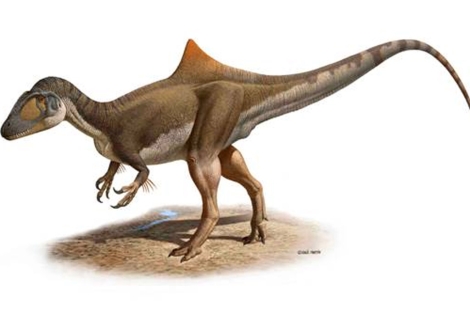
Reconstruction of the possible aspect of C. corcovatus, by Raul Martin. Alternative recreations here and here, thanks to Alain Bénéteau.

Unearthed from Las Hoyas deposit (Cuenca, Spain), the fossil of this theropod surprised its discoverers at first due to the bone prolongation of the front vertebrae of its pelvis, responsible for its notorious hump. This feature led this new species to be baptized as Concavenator corcovatus ("hunchback hunter of Cuenca").

However, the importance of this fossil, nicknamed "Pepito" by the paleontologist that brought it to light, goes beyond the peculiarity described lines above. In fact, its arms have small bumps that are very similar to those present in the Coelurosaurids and their living descendants, the Birds, that hold the large wing feathers used by the latter for powered flight.

The fascinating (and exciting) thing about this feature is that "Pepito" belongs to a group of dinosaurs (the
Allosaurids) which representatives, until now, did not presented any evidence of having feathers or similar structures. The discovery of this Spanish reptile may indicate that feathers would have appeared far before of what was considered this far, i.e., in the more primitive dinosaurs that were common ancesters for Coelurosaurids as well as for the group that contains C. corcovatus.

Underlined in red in the graphic bellow (based on a cladogram proposed by Weishampel et al. in 2004) are the dinosaur groups whit at least one feathered representative:


As can be seen, the Alosaurids may ben counted from now on within the feathered dinosaurs thanks to the discovery of the Concavenator.

The find of "Pepito" seems to underpin the idea that feathers were a feature common to all dinosaur groups, along with evidence from species with no relation with theropods such as the Psittacosaurus and the Tianyulong, which may have had (at least) proto-feathers.

Yes, I know: and what about the hump? Well, about it, two hypothesis have been formulated so far:
  1. That it may have been (as usual) an exhibitional structure to attract females.
  2. That it may worked as a thermal regulator element, likewise the Spinosaurus sail, animal main character of the latest movie of the Jurassic Park saga.
Some final data on C. corcovatus:
  • The Cuenca fossil is the most complete dinosaur scheleton discovered in Spain so far. Even fossilized skin was discovered.
  • It lived between 130 and 125 million years ago approximately, during the Early Cretaceous.
  • It was about four meters long.
More information on "Pepito" can be found here.

Dinosaurs and Heavy Metal!

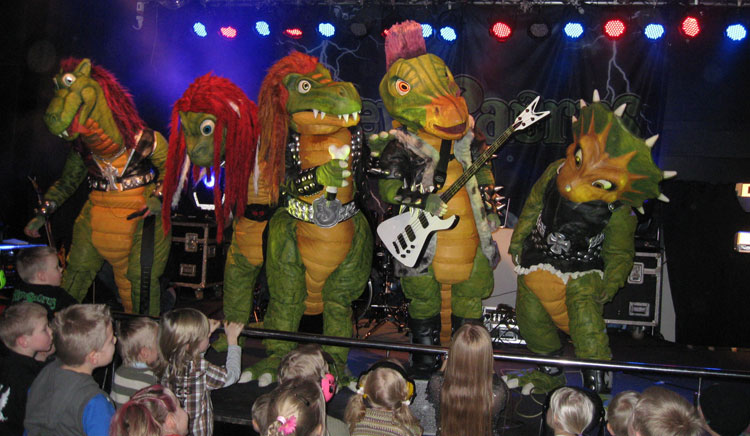
What else can I ask for? I give you Hevisaurus, Finnish band of "Dino-Metal". No wonder Newsweek declared Finland as the best country of the world.


This post may be anything but scientific, but simply this blog could not leave pass by a marvel like this. One single example may prove my point: the music video of Jee Hevisaurus, second track of the album Jurahevin Kuninkaat ("Kings of Jurassic Heavy" in Finnish).


For those of you who can't access the video for the nonsense of a company that took down the YouTube profile of its artist for uploading her own music videos, you can watch it here.

More information on the band here and here.

JEE HEVISAURUS!

The bad guy in the neighborhood would not come alone

Indeed, before coming, he may have sent his minions to play havoc. I am talking about the asteroid that is believed to have impacetd the Earth about 65 million years ago and that is thought to have caused the Cretaceous-Tertiary extinction event.


The discovery of a crater in Ukraine and its date would strengthen the theory that the end of the reign of dinosaurs was not caused by a single impact of an asteroid with our planet, but by a meteor shower that would have lasted several thousand years.

The Boltysh crater (Kirovohrad, Ukraine) was discovered in the 60s during an oil exploration. However, its correct dating could only be done until recently through the study of fossil spores, establishing that the asteroid that caused it would have impacted between 2 and 5 thousand years before the most famous meteorite responsible for the Chicxulub crater (Yucatan, Mexico).

The date of the impact, established by a team of investigators of the Aberdeen University leaded by the Geology Doctor David Jolley, was published through an article of the Geology magazine in August 2010. The study states that it is highly probable that between the impacts of Boltysh and Chicxilub may have been several similar collisions, being a millenary meteor shower the responsible for the massive extinction event of the end of the Cretacic and not a single happening.

The meteor that fell onto the Cretaceous Ukraine may have eradicated much of the biodiversity that at that time populated Eastern Europe and Russia. Similar events over thousands of years would have done the same in different parts of the globe, until the end of the Mesozoic party was declared by the arrival of the Yucatan asteroid.
You may find more information here.

Finally, I leave you with a very illustrative video (with a very sardonic ending if you ask me) abaout the possible consequences of an asteroid impact with our planet.


Original image by Lee Krystek, slightly adapted by your humble servant.

Great-great-grandfathersuchids and great-great-grandsonsaurids

Bellow, the most recent genealogical tree of the dinosaurs (until 2008), elaborated by the Bristol University. It includes 99,2% of the species discovered so far:


Yes, I know, is as big as a Baobab. Here you can find a larger article on this marvel.

Tri-toro-cera-top-saurus?

Ok. This is the story that inspired me to start this blog:

"Study discovers that Triceratops and Torosaurus were different stages of the same dinosaur"

It turns out that John Scanella, postgraduate student of the Montana State University (MSU), and Jack Horner, paleontologist very well recognized in the scientific scene, have published a study that states that Triceratops, one of the most famous dinosaurs of the world (maybe as much as its contemporary, the Tyrannosaurus rex) was nothing but a juvenile form of the animal known until now as Torosaurus, a reptile quite more anonymous in the popular imaginary.


Proposal of Scanella and Horner about the juvenile (izq.) and adult (right) appearences of the Triceratops face, formerly assigned to adult specimens of Triceratops and Torosaurus, respectively. Original image available at Physorg.com


Getting aknowledge about this story, published in the July 14th edition of the Journal of Vertebrate Paleontology magazine of the The Society of Vertebrate Paleontology, made me feel something like when I first saw the "Star Wars: The Empire Strikes Back" scene in which Luke Skywalker discovers that Darth Vader is his father.Well, maybe I'm exagerating, but I was truly astonished and felt my interest in science journalism renewed.

Back to topic, the most immediate consequence of this study is that the genus "Torosaurus" will disappear from the scientific texts and the name "Triceratops" will prevail, as this term was coined first and, in situations like this, the first in line is the only one to stay (as has happened before with the denomination "Brontosaurus").

However, this discovery has more profound implications. If the affirmation of Scanella and Horner is true, it will become one more proof to support the theory that the biodiversity of the dinosaurs was, by the end of the Cretaceous, less more than was thought some years ago.

In other words, the dinosaurs may have been already on their way to extinction by the time the asteroid that created the Chicxulub crater impacted the Eartch about 65 million years ago. This celestial clash is considered as one of the most possible causes of the Cretaceous-Tertiary extinction event, which meant the end of the Mesozoic Era (popularly known as the Age of Reptiles or the Age of Dinosaurs) and the beginning of the Cenozoic Era, also called the Age of Mammals, within which we still live.