Originally from the Cat versus Human blog.
Pages
Monday, October 11, 2010
Wednesday, October 6, 2010
Sunlight our future
So, we all know that using crude oil for feeding our civilization has several environmental, social and economical cons. Looking for a viable, clean and cheap source of energy is an imperative. Solar energy has been seen for a long time as promising replacement for petroleum, but, how feasable is to use it?
Well, solar power is still vigorous, at least according to iSuppli, a market research firm. Thru a press release, iSuppli states that the market for this kind of energy is expected to grow more than 40% in 2011 compared to this year. However, solar energy market has shrunk compared to 2009, when it grew almost 98% compared to the precedent year.
Recently, the South African government anounced that they are building the biggest solar energy plant ever constructed. As well, Europe will have its biggest solar energy plant in Italy.
Parabolic dishes in Almeria, Spain, used to obtain solar energy. Photo by the Sandia National Laboratory.
Well, solar power is still vigorous, at least according to iSuppli, a market research firm. Thru a press release, iSuppli states that the market for this kind of energy is expected to grow more than 40% in 2011 compared to this year. However, solar energy market has shrunk compared to 2009, when it grew almost 98% compared to the precedent year.
Graphic by iSuppli
Recently, the South African government anounced that they are building the biggest solar energy plant ever constructed. As well, Europe will have its biggest solar energy plant in Italy.
Tuesday, October 5, 2010
A new (?) eurogiant
From the almost prehistoric times when there was no Internet, I am back with some news about our old good fellows, the dinosaurs. This time we go again to Spain, exactly to Teruel, where a team of paleontologists has discovered the fossil of the largest dinosaur's femur (the upper bone of the leg) ever to be found in Europe.
Location of Teruel, Spain
Along with the femur, which measures 1,92 m, there have been found a right tibia 1,25 m long, 15 tail vertebrae, 11 chevrons, a nearly complete set of teeth and part of the skull. The sediments surrounding the bones are 145 million years old, so this dinosaur may have lived in between the late Jurassic and the early Cretaceous.
Photo by Dinopolis, the Teruel dinosaur thematic park.
In 2006, Turiasaurus riodevensis (something like "lizard of Riodeva, Turia", being Turia the latin name for Teruel), the biggest European dinosaur known until now (with a lenght exceeding 30 m), was unearthed from this same spot (the Riodeva dig). However, the discovery can't be yet assigned to a species, neither T. riodevensis nor a new one.
Reconstruction of Turiosaurus riovedensis, by Carin L. Cain.
Sunday, September 26, 2010
The flamboyant, brand-new Triceratops's cousins
Two new species of Ceratopsians (group of horned, plant-eating dinosaurs whose most famous representative is the Triceratops) have been discovered in Utah, U.S.A. The bigger of them has been named Utahceratops ("Horned face from Utah") and is interesting mainly because of its almost horizontal brow horns, a completely new feature within Ceratopsians. The other one is simply too baroque: it has 15 horns! Kosmoceratops (something like "Ornamented horned face"), has the most decorated head of all Dinosaurs discovered so far.
Once believed to be used as a defense against carnivores, the horns and all other features that were characteristic of Ceratopsids skulls are now thought to be mainly ornamental. Each species had a very particular set of horns and neck frills that may be used to spot representatives of their own kind, as well as to show off and engage in battle between males during the mating season, the same way as most Cervids do nowadays.
Like Ceratopsians? This is the second post of this blog related to this group of Dinosaurs. Click here to see the first one.
Artist's reconstructions of the heads of Kosmoceratops (left) and Utahceratops (right), by Lukas Panzarin.
Comparison between the Utahceratops (left) and Kosmoceratops (right) skeletons, by Scott D. Sampson et al. The bones colored in yellow are the ones that were recovered.
Like Ceratopsians? This is the second post of this blog related to this group of Dinosaurs. Click here to see the first one.
Saturday, September 25, 2010
30 seconds on Mars
Brief news on the red planet and related stuff:
- Last week, NASA's Mars Reconnaisance Orbiter (MRO) spoted rocks from a Martian area called Nili Fossae that may contain fosilized life, as they are very similar to Stromatolites, rocky formations from Pilbara, Australia, that were created by the activity of some of the earliest life forms on Earth.
- This week, the MRO rebooted and put itself in safe mode for an unknown reason, but it's back online.
- Meanwhile, Italian astrophysicists stated during the European Congress of Planetary Science that Phobos (one of the two Martian moons, being the other one Deimos) may have been originated from an asteroid impact with Mars and that is not a meteorite captured by the red planet, as it was previously thought.
Mars.
Tuesday, September 21, 2010
Shrunk and gone: a story about the Moon
Have you ever seen the Moon low in the horizon, when it is just rising? Do you remember how big it looks at that moment and how it seems to have shrunk when it is high in the sky? Well, even if this phenomenon is caused by an optical illuson, our natural satellite is actually shrinking.
The Lunar Reconnaisance Orbiter (LRO), an artificial satellite launched on June18th, 2009 by the US's National Aeronautics and Space Administration (NASA) to study the Moon discovered what have been called lobated scarfs, a type of cliffs caused by the Moon's shrinkage.
So, the Moon is shrinking, but is still ours, as always, right? Well, not forever, because the Moon is actually moving away from us and will eventually be gone forever.
The gravitational interaction between the Earth and the Moon that is responsible for the tidals of our seas is causing our natural satellite to be 3,8 cm farther away from us and is accelerating its revolution time around our planet to compensate this fact.
So, the Moon will look smaller and smaller each year in the sky and someday, in a very distant future, it won't be there no more. Don't believe me? Just watch:
Now, here's the explanation on why this is happening:
More information on the shrinking Moon can be found here.
Photograph by Justo Ruiz.
The Lunar Reconnaisance Orbiter (LRO), an artificial satellite launched on June18th, 2009 by the US's National Aeronautics and Space Administration (NASA) to study the Moon discovered what have been called lobated scarfs, a type of cliffs caused by the Moon's shrinkage.
The data obtained by the LRO shows that the Moon has reduced its radius in 100 m during a yet indetermined time span -it may go from one hundred thousand (1 x 10⁵) to one billion (1 x 10⁹) years. Yet, the Moon's shrinkage, caused by the cooling of its is interior, is not affecting its crust as it is already cold, thus causing this one to wrinkle. This is, roughly, how the lobated scarfes are originated.
Graphic showing how lobated scarfs are created, as the Moon's crust is pushed together due to our natural satellite's shrinkage. Image by NASA.
So, the Moon is shrinking, but is still ours, as always, right? Well, not forever, because the Moon is actually moving away from us and will eventually be gone forever.
The gravitational interaction between the Earth and the Moon that is responsible for the tidals of our seas is causing our natural satellite to be 3,8 cm farther away from us and is accelerating its revolution time around our planet to compensate this fact.
So, the Moon will look smaller and smaller each year in the sky and someday, in a very distant future, it won't be there no more. Don't believe me? Just watch:
Now, here's the explanation on why this is happening:
More information on the shrinking Moon can be found here.
Thursday, September 16, 2010
So far yet so close (at least roughly)
By the end of August 2010, the biggest extrasolar planetary system discovered so far was announced by a team of European astronomers from the European Southern Observatory (ESO).
Five planets have been confirmed to orbit HD 10180, a star very similar to our Sun located 127 million light-years from us, within the Hydrus constellation. There is also the possibilty that two more planets orbit the star and, if that's the case, the HD 10180 system will be almost as big as ours, given that our cosmic neighborhood consists of eight planets (Pluto is no longer one, remember?).
Yet, seemingly so close to our solar system, there are major differences to take into account. The five confirmed planets are as big as Neptune and their orbits span from six to 600 Earth days.
One of the unconfirmed planets may be the size of Saturn and would orbit HD 10180 in 2200 Earth days. The other one may be 1,4 times the size of our planet, but it's yet quite far from habitable (at least by us) as it would be so close to its star that its "year" lasts only 1,18 Earth days. Besides that, this "evil twin" of the Earth is the smallest planet discoverd so far.
The discovery of this rich extrasolar planetary system took about six years and was performed using the world's most powerful spectrograph, an instrument that captures and analyzes light signatures, at ESO's telescope at La Silla, Chile.
The first extrasolar planet was discovered in 1995 around 51 Pegasi and was called 51 Pegasi b, being abbreviated as 51 Peg b and nicknamed Bellerophon. As of September 8th, 2010, there have been announced 490 confirmed detections of such celestial bodies.
More information on the HD 10180 system can be found here. As well, an official video from ESO about the program can be seen below.
Artist recreation of the recently discovered extrasolar planetary system. Original image from ESO.
Five planets have been confirmed to orbit HD 10180, a star very similar to our Sun located 127 million light-years from us, within the Hydrus constellation. There is also the possibilty that two more planets orbit the star and, if that's the case, the HD 10180 system will be almost as big as ours, given that our cosmic neighborhood consists of eight planets (Pluto is no longer one, remember?).
Yet, seemingly so close to our solar system, there are major differences to take into account. The five confirmed planets are as big as Neptune and their orbits span from six to 600 Earth days.
One of the unconfirmed planets may be the size of Saturn and would orbit HD 10180 in 2200 Earth days. The other one may be 1,4 times the size of our planet, but it's yet quite far from habitable (at least by us) as it would be so close to its star that its "year" lasts only 1,18 Earth days. Besides that, this "evil twin" of the Earth is the smallest planet discoverd so far.
The discovery of this rich extrasolar planetary system took about six years and was performed using the world's most powerful spectrograph, an instrument that captures and analyzes light signatures, at ESO's telescope at La Silla, Chile.
The first extrasolar planet was discovered in 1995 around 51 Pegasi and was called 51 Pegasi b, being abbreviated as 51 Peg b and nicknamed Bellerophon. As of September 8th, 2010, there have been announced 490 confirmed detections of such celestial bodies.
More information on the HD 10180 system can be found here. As well, an official video from ESO about the program can be seen below.
Wednesday, September 15, 2010
One hundred days of solitude (so far)
Now we jump from the prehistoric times to a not so far future, a time when the first manned mission to Mars is deployed. When is this going to happen? So far, nothing's for sure, but, if we trust Barack Obama, it's going to happen by the third decade of this century.
The first 250 days of isolation will consist in the "trip to Mars", followed by 30 days for "orbiting and landing on Mars", while the final 240 days will be for "going back to Earth". The presumed distances
This experiment is being carried out by Russia's Institute for Biomedical Problems (IBMP), the Russian Academy of Sciences and the European Space Agency (ESA) and is the third phase of the Mars500 program.
The first stage, developed during November 2007, consisted in a 15-days isolation for equipment, facilities and operating procedures testing and involved a different group of six volunteers (one of them being a woman). The second phase of the Mars500 program, developed with an all-Russian team, consisted in a trip simulation similar to the one being currently held, but designed to last only 105 days. It was completed on June 3rd, 2010.
But now, here on Earth, specifically in Moscow, Russia, a experiment is already being held regarding the effects on humans that the long journey from our planet to Mars may cause. Six male volunteers from Russia (3), Italy (1), France (1) and China (2) have been living isolatedly for about one hundred days in an facility designed ad hoc for testing the psychological demands of an interplanetarian trip.
The Mars500 crew. Photo from ESA's Mars500 program page.
Leaded by Commander Alexei Sitev, a Russian engineer, the team will leave the facility they have been living in since June 3rd, 2010 by the day 520 of isolation, i.e., on November 5th, 2011. Until that date, the men will have to share a space consisting in four hermetically sealed interconnected sections, consisting in habitable, medical and storage modules, as well as a Mars Landing simulator. They even have gym and sauna.
The first 250 days of isolation will consist in the "trip to Mars", followed by 30 days for "orbiting and landing on Mars", while the final 240 days will be for "going back to Earth". The presumed distances
This experiment is being carried out by Russia's Institute for Biomedical Problems (IBMP), the Russian Academy of Sciences and the European Space Agency (ESA) and is the third phase of the Mars500 program.
The first stage, developed during November 2007, consisted in a 15-days isolation for equipment, facilities and operating procedures testing and involved a different group of six volunteers (one of them being a woman). The second phase of the Mars500 program, developed with an all-Russian team, consisted in a trip simulation similar to the one being currently held, but designed to last only 105 days. It was completed on June 3rd, 2010.
More information on the Mars500 program can be found here.
Tuesday, September 14, 2010
The hunchback of Cuenca
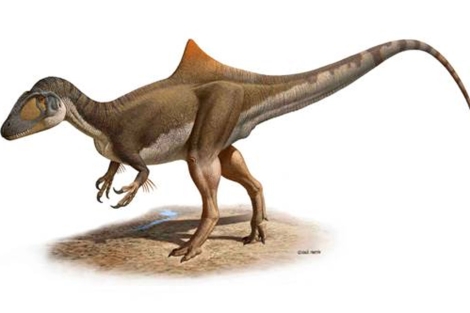
Reconstruction of the possible aspect of C. corcovatus, by Raul Martin. Alternative recreations here and here, thanks to Alain Bénéteau.
Unearthed from Las Hoyas deposit (Cuenca, Spain), the fossil of this theropod surprised its discoverers at first due to the bone prolongation of the front vertebrae of its pelvis, responsible for its notorious hump. This feature led this new species to be baptized as Concavenator corcovatus ("hunchback hunter of Cuenca").
However, the importance of this fossil, nicknamed "Pepito" by the paleontologist that brought it to light, goes beyond the peculiarity described lines above. In fact, its arms have small bumps that are very similar to those present in the Coelurosaurids and their living descendants, the Birds, that hold the large wing feathers used by the latter for powered flight.
The fascinating (and exciting) thing about this feature is that "Pepito" belongs to a group of dinosaurs (the
Allosaurids) which representatives, until now, did not presented any evidence of having feathers or similar structures. The discovery of this Spanish reptile may indicate that feathers would have appeared far before of what was considered this far, i.e., in the more primitive dinosaurs that were common ancesters for Coelurosaurids as well as for the group that contains C. corcovatus.
Underlined in red in the graphic bellow (based on a cladogram proposed by Weishampel et al. in 2004) are the dinosaur groups whit at least one feathered representative:
As can be seen, the Alosaurids may ben counted from now on within the feathered dinosaurs thanks to the discovery of the Concavenator.
The find of "Pepito" seems to underpin the idea that feathers were a feature common to all dinosaur groups, along with evidence from species with no relation with theropods such as the Psittacosaurus and the Tianyulong, which may have had (at least) proto-feathers.
Yes, I know: and what about the hump? Well, about it, two hypothesis have been formulated so far:
- That it may have been (as usual) an exhibitional structure to attract females.
- That it may worked as a thermal regulator element, likewise the Spinosaurus sail, animal main character of the latest movie of the Jurassic Park saga.
Some final data on C. corcovatus:
- The Cuenca fossil is the most complete dinosaur scheleton discovered in Spain so far. Even fossilized skin was discovered.
- It lived between 130 and 125 million years ago approximately, during the Early Cretaceous.
- It was about four meters long.
Dinosaurs and Heavy Metal!
What else can I ask for? I give you Hevisaurus, Finnish band of "Dino-Metal". No wonder Newsweek declared Finland as the best country of the world.
For those of you who can't access the video for the nonsense of a company that took down the YouTube profile of its artist for uploading her own music videos, you can watch it here.
More information on the band here and here.
JEE HEVISAURUS!
This post may be anything but scientific, but simply this blog could not leave pass by a marvel like this. One single example may prove my point: the music video of Jee Hevisaurus, second track of the album Jurahevin Kuninkaat ("Kings of Jurassic Heavy" in Finnish).
More information on the band here and here.
JEE HEVISAURUS!
Subscribe to:
Posts (Atom)